Architectural Foundations of
Touchable® Cardiovascular Surfaces
A Distributed Biosensing Topology.
Document ID:BSTH-WP-001|Version:1.0|Revision date:|Status:Public|Issued by:BioStealthAI|Draft start:2025-06Prepared by:BioStealthAI Systems Architecture Team|Lead author:Israel Ninsaw Gbati|Technical review:Olivier Tsiakaka, PhD, Mohamed AlezzabiIntended audience:Systems Engineers; Platform Architects; Physiological Sensing R&D Leaders|Contact:partnerships@biostealth.ai
Scope and disclosure note
This paper describes architecture-level concepts for surface-level physiological sensing. It is intended to clarify system topology, integration posture, and platform implications. Implementation specifics such as sampling rates, wavelengths, thresholds, physical dimensions, manufacturing recipes or material stack-ups vary by embodiment and are outside the scope of this paper. Examples are illustrative and non-exhaustive. System behavior and performance depend on embodiment, integration choices, and operating context. This paper is not a medical or diagnostic document.
Nothing in this document is intended to define, limit, or characterize the scope of any patent claims, or to constitute an admission about the state of the art.
Abstract
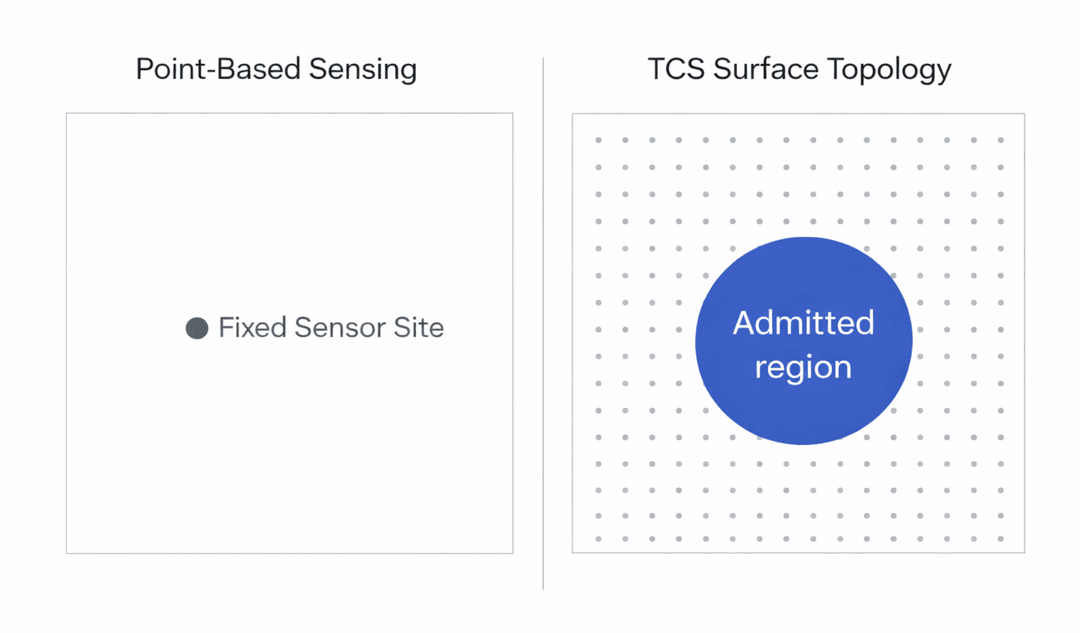
The prevailing model of physiological sensing remains spatially constrained and behaviorally dependent. Many deployments rely on point-based acquisition, often through worn devices or fixed sensor sites, and depend on deliberate user participation.
Touchable Cardiovascular Surfaces (TCS) depart from that model. TCS is a surface-level physiological sensing architecture designed to transform passive touch surfaces into contact-conditioned physiological interfaces while preserving the familiar behavior of the host surface. It achieves this through distributed photonic sensing locations that may be admitted locally during touch, evaluated for suitability, and routed into a disciplined output stream aligned with host integration.
This whitepaper defines the core architecture of TCS, including its sensing stack, control hierarchy, suitability gating and selection logic, power posture, and integration model. The platform perspective is central: TCS is not merely a sensor placed under a surface. It is a surface-level sensing architecture that coordinates sensing, admission, and disciplined export.
1. System overview.
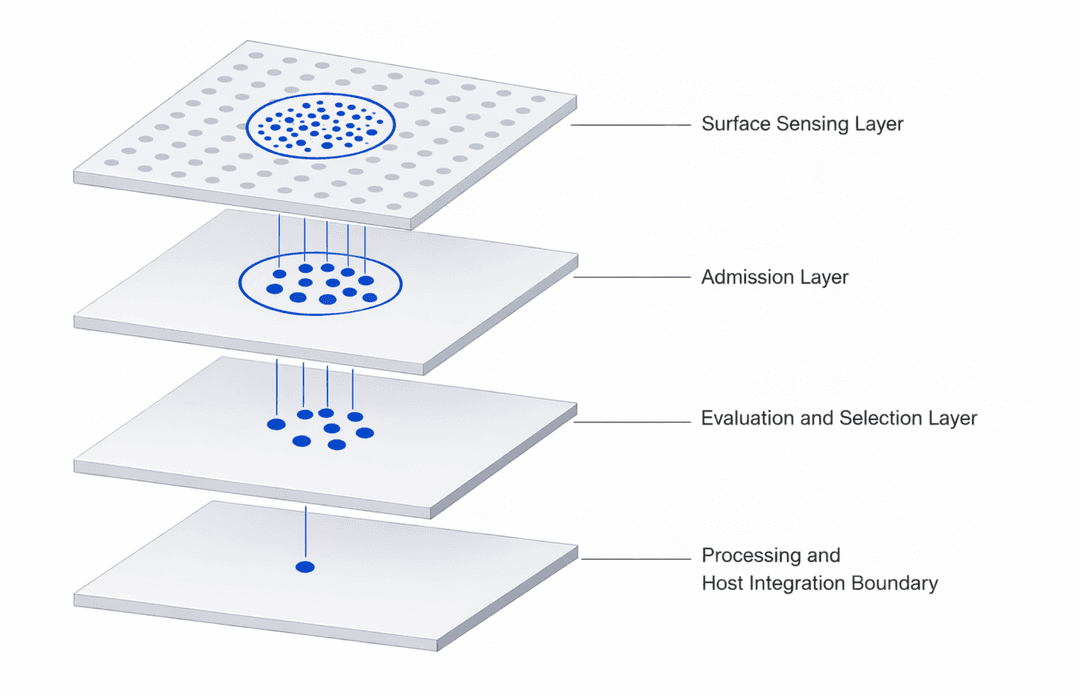
TCS can be described as a surface-level physiological sensing architecture, not as a conventional point sensor relocated into a larger area. In typical deployments, the surface can remain low-activity until interaction at the surface interface is detected. When interaction occurs, the system may admit a localized region of interest, evaluate multiple candidate sensing locations associated with that region, and select one or more suitable signals for downstream processing based on configured criteria. As interaction geometry shifts over time, selection may adapt to preserve continuity without imposing a new user ritual.
At a high level, a sensing location within a TCS surface can include an illumination element configured to support optical sensing of blood-volume-related changes in tissue, a sensing element for optical acquisition, interface circuitry supporting localized activation and signal acquisition, and control connectivity to a shared coordination layer.
This architecture shifts surface sensing away from fixed placement and persistent polling, toward contact-conditioned admission, local suitability gating, and disciplined export aligned to the host system.
2. Activation and control
TCS is organized around an event-driven surface behavior: sensing resources can be engaged in response to contact, rather than acquired continuously across an entire field. This is the architectural inverse of many sensor arrays that treat sensing as an ongoing scan.
2.1 Admission layer
In this paper, touch and contact refer to the common case of a proximate object at the surface interface.
Contact context can be detected through one or more surface-appropriate mechanisms, depending on embodiment. The architectural purpose is consistent: admit a region of interest when interaction occurs, and keep other regions in a low-activity state when they are not relevant.
2.2 Candidate evaluation
Within an admitted region, multiple sensing locations may participate in acquisition. Signals from these candidates may be evaluated against one or more suitability criteria. The criteria can reflect qualities such as stability, coherence, ambient influence, and motion-related disturbance, depending on implementation and policy.
2.3 Suitability gating and selection
Signals that meet suitability conditions may be routed for downstream processing. When conditions change, the system may re-evaluate candidates and transition to a different suitable signal. This provides continuity as grip, pressure, or contact position evolves, without requiring the user to repeatedly reposition or restart a session.
This control hierarchy is a defining element of the topology: it turns a dense surface into a disciplined physiological interface rather than an unbounded collection of raw channels.
3. Sampling posture
TCS can be understood as temporally continuous during interaction while remaining spatially conditional.
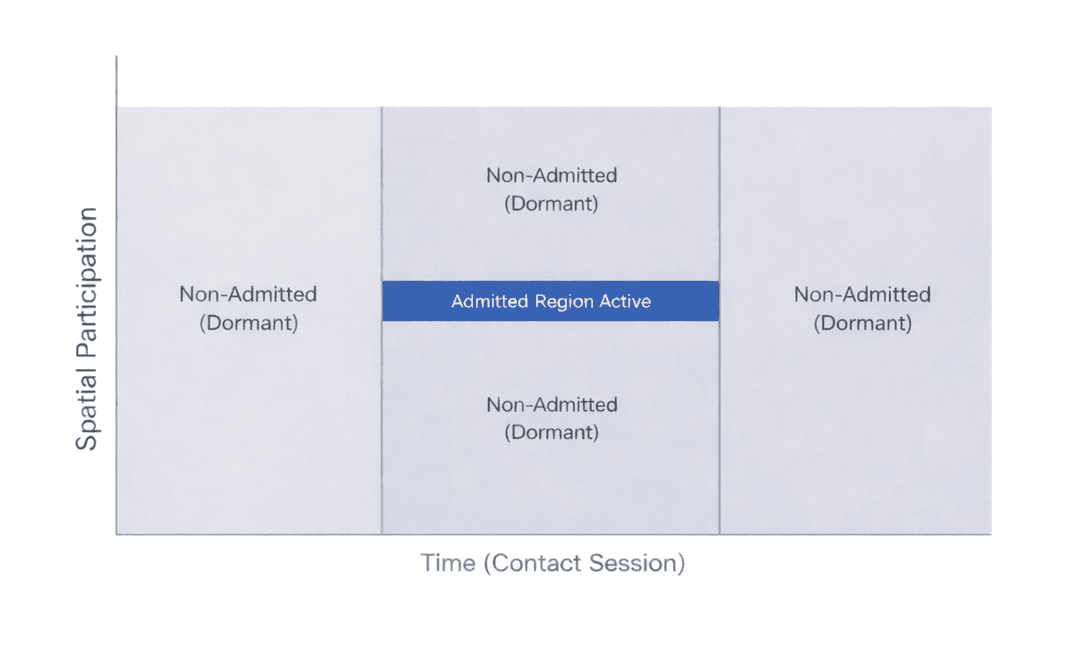
- Temporal acquisition can be sustained during contact sessions when policy and integration call for it.
- Spatial participation can remain bounded to admitted regions and candidate subsets rather than spanning a full surface field.
- Acquisition and processing can be scheduled and coordinated in a way that balances signal continuity with power and thermal constraints.
The key is architectural: TCS treats spatial admission and suitability gating as the mechanism that makes surface-level physiological capture practical and stable. It avoids the failure mode of treating the entire surface as one aggregated analog source, which can dilute or corrupt physiological signal structure when unrelated regions are mixed.
4. Power posture
TCS is engineered around local activation.
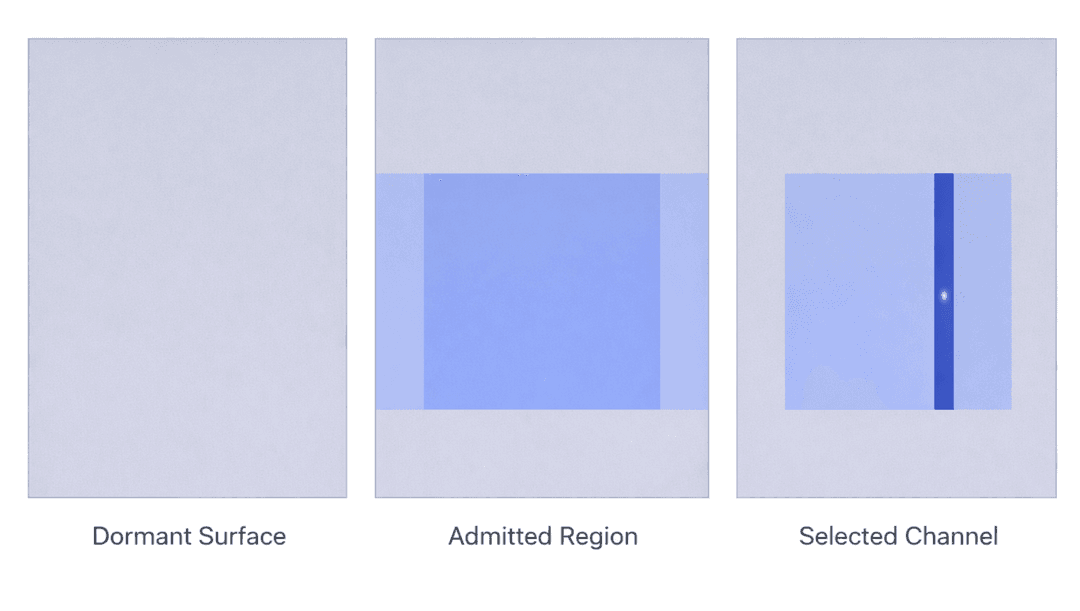
- In quiescent states, large portions of the surface may remain in low-activity modes.
- During interaction, resources can be concentrated in the admitted region and associated candidate subset.
- In some embodiments, downstream streaming can focus on one selected signal at a time; other embodiments may support multiple signals depending on use case and policy.
This posture supports practical deployment in systems with constrained power budgets, while preserving the familiar behavior of the host surface during normal use.
5. Signal integrity and inference
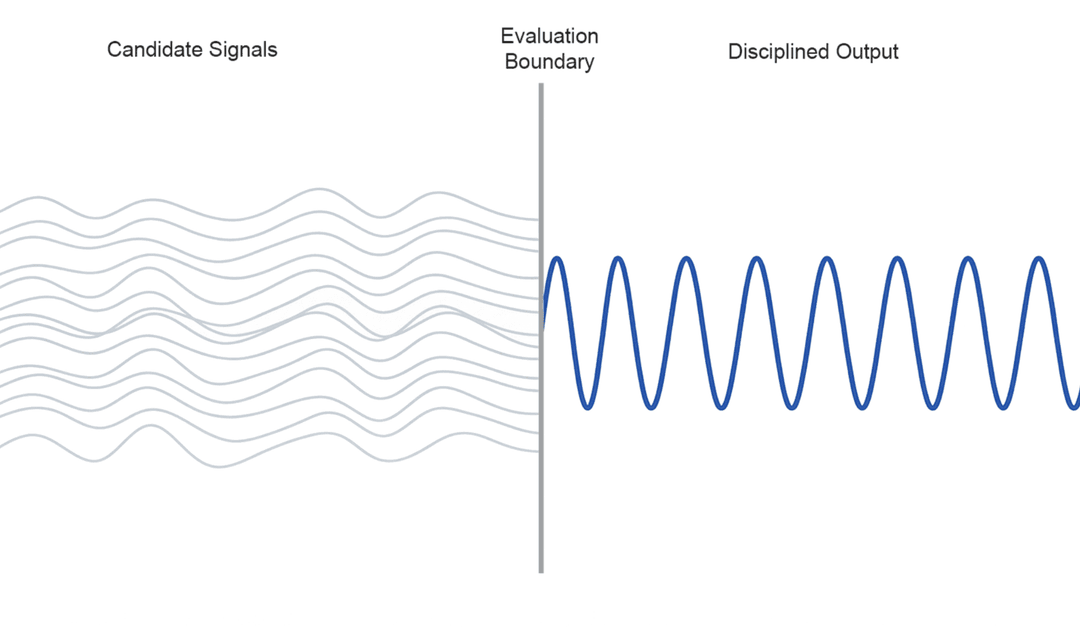
TCS is also designed to support disciplined physiological signals suitable for real-time use in interactive systems.
5.1 Local signal conditioning
Within the admitted region, signals may be conditioned locally before export. Depending on embodiment, local conditioning can include:
- managing slow drift associated with contact variation
- reducing ambient influence through illumination and sensing coordination
- suppressing motion-related disturbance through stability-aware gating
The purpose is architectural: keep the host interface clean and bounded, and avoid exporting uncontrolled surface-wide raw data.
5.2 Real-time signal interpretation
Depending on integration choices, and in embodiments specifically configured and validated for such indicators, the system may compute or package indicators such as heart rate, variability-related measures, pulse waveform characteristics, blood pressure trend surrogates, vascular tone related indicators, blood oxygen saturation and waveform morphology characteristics such as rise and decay behavior. These examples are illustrative. Selection of outputs, computation location, and validation requirements are integration-dependent.
6. Software interface and system integration
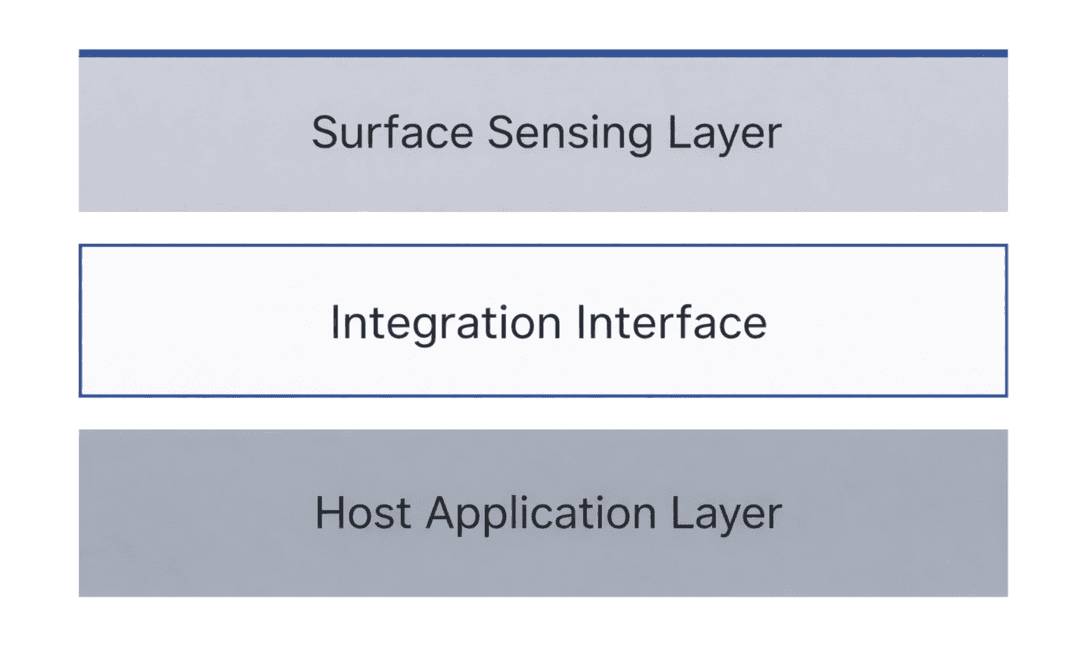
TCS surfaces can expose a structured interface layer so the surface may be treated as a subsystem in broader platforms.
Data channel examples
- synchronous streaming during contact sessions, where one or more suitable signals may be provided
- event-oriented summary outputs, where derived indicators can be reported at policy-defined intervals
- waveform-level access in controlled integration modes, bounded to admitted regions and disciplined channels rather than unconstrained surface-wide export
Control surface examples
- region admission and deactivation controls
- evaluation or self-test requests appropriate to the integration context
- policy controls related to power and acquisition scheduling
- triggers for re-evaluation when conditions change
7. Embodiment flexibility
TCS is an architectural sensing layer that can apply across a range of applications and form factors. The topology is not locked to one object type or one physiological output.
Example embodiments include:
- a compact curved surface designed to instrument palm contact during interaction
- a work surface zone that supports physiological sensing during repeated contact events
8. Architecture in context
The TCS architectural model can be understood as a system-level operating model expressed across several dimensions. From a sensing topology perspective, it moves from point-based acquisition toward distributed surface participation that is admitted locally based on interaction at the surface. In power posture, it shifts from persistent operation to a dormant- by-default approach with localized activation during interaction.
In activation logic, the model emphasizes event-driven admission and subset engagement rather than surface-wide continuous activity. In routing behavior, it supports adaptive selection among candidate sensing locations as conditions evolve, rather than relying on a fixed channel. At the system boundary, it favors disciplined export of bounded physiological channels over surface-wide raw data exposure. Finally, in integration posture, it treats the surface as a governed subsystem rather than a discrete sensor, with admission, evaluation, selection, and export coordinated under policy aligned to host platform needs.
9. Conclusion
TCS marks a shift in how surfaces can capture cardiovascular-related physiological information. Rather than relying on point-based sensing or user-managed placement, a surface can admit a region of interest during contact, evaluate candidate signals for suitability, and export a disciplined physiological stream aligned to host integration.
TCS transforms the surface from a passive boundary into a physiological interface embedded into the objects and environments people already touch.