Camera Imaging Compared to
Touchable® Cardiovascular Surfaces
Document ID:BSTH-WP-003|Version:1.0|Revision date:|Status:Public|Issued by:BioStealthAI|Draft start:2025-12Prepared by:BioStealthAI Systems Architecture Team|Lead author:Israel Ninsaw Gbati|Technical review:Mohamed Alezzabi, Olivier Tsiakaka, PhDIntended audience:Systems Engineers; Platform Architects; Physiological Sensing R&D Leaders|Contact:partnerships@biostealth.ai
Scope and disclosure note
This paper describes architecture-level concepts for surface-level physiological sensing. It is intended to clarify system topology, integration posture, and platform implications. Implementation specifics such as sampling rates, wavelengths, thresholds, physical dimensions, manufacturing recipes or material stack-ups vary by embodiment and are outside the scope of this paper. Examples are illustrative and non-exhaustive. System behavior and performance depend on embodiment, integration choices, and operating context. This paper is not a medical or diagnostic document.
Nothing in this document is intended to define, limit, or characterize the scope of any patent claims, or to constitute an admission about the state of the art.
Abstract
Cameras and Touchable Cardiovascular Surfaces (TCS) can both involve light, but they occupy different architectural categories and produce fundamentally different data.
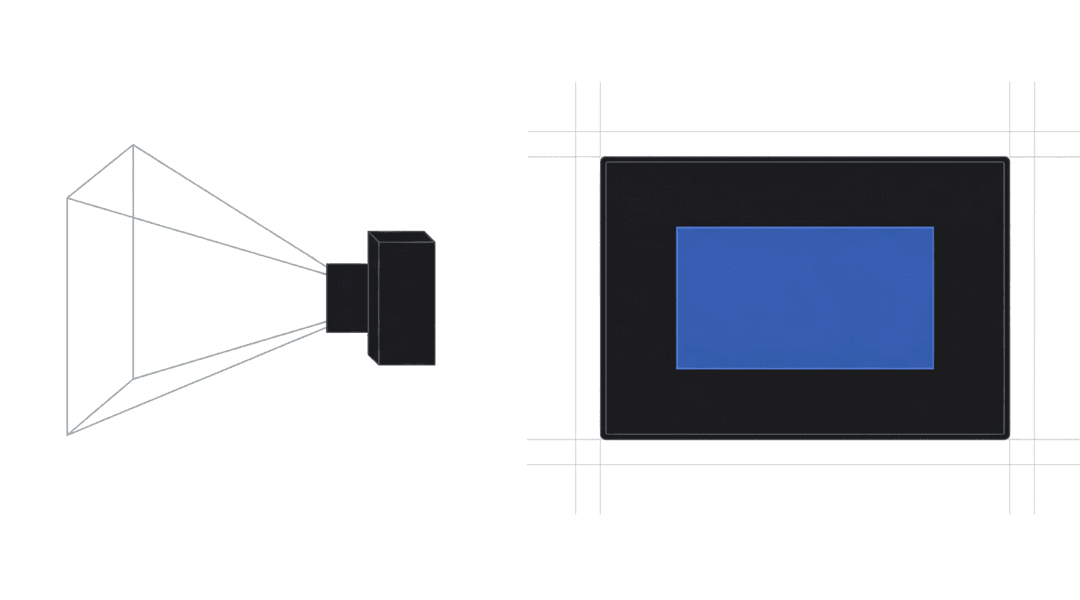
Camera systems are typically designed to reconstruct scenes from spatial intensity patterns across a field of view. TCS is a surface-level physiological sensing architecture designed to sense during contact, admit a localized region of interest, evaluate signal suitability, and export a disciplined physiological signal aligned to host integration.
This paper clarifies what TCS is and is not in relation to camera imaging, with emphasis on modality boundaries, data characteristics, privacy posture, and practical integration implications for OEM platforms.
1. Introduction and framing
In technical discussions, it is common for “optical sensing” to be grouped into a single bucket. That grouping can be misleading. Camera imaging and surface-level physiological sensing differ on first principles:
- what is being measured
- how the signal is coupled to the world
- what the raw data represents
- what privacy exposure is inherent to the modality
- how system performance depends on placement and environment
TCS is distinct from camera imaging at the architectural level. It is a surface-integrated physiological interface that uses contact context as a gating boundary and produces a compact time-domain output rather than scene content.
In this paper, touch and contact refer to the common case of a proximate object at the surface interface.
A practical note: comparisons in this paper describe modality and architecture. Specific performance depends on embodiment, optics, integration, and operating context.
2. Architectural foundation
2.1 Camera imaging in architectural terms
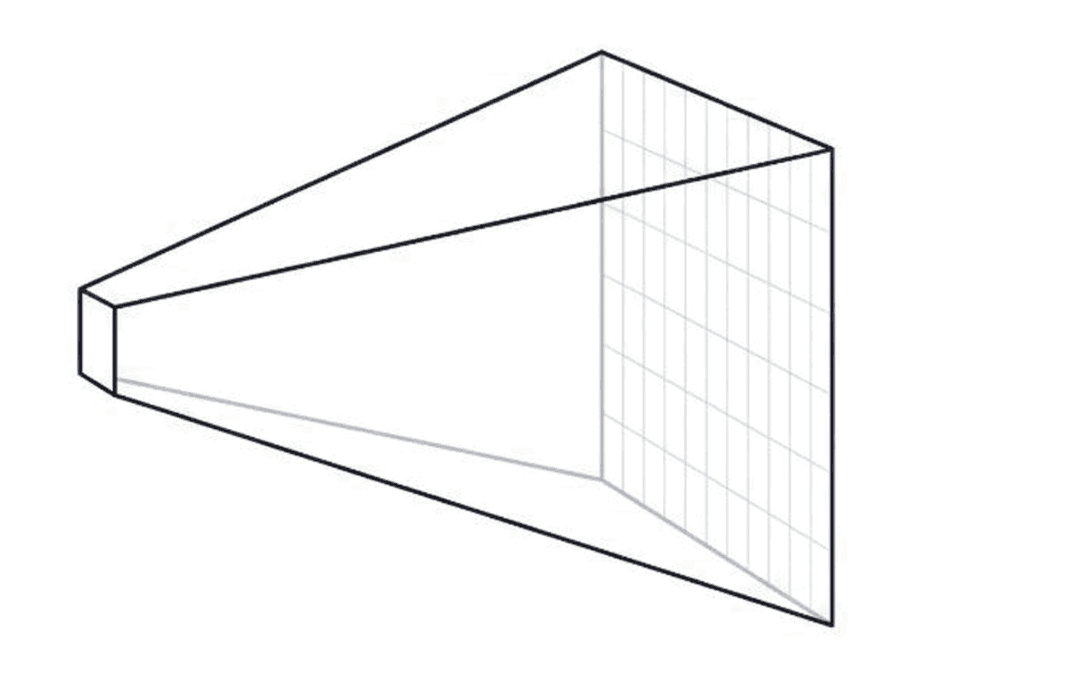
In architectural terms, a camera system is organized around a capture volume, a pixel field, and a downstream pipeline that reconstructs and interprets visual content from image frames. Its operating assumptions are tied to scene visibility, subject placement, and the quality of line-of-sight acquisition. This makes camera imaging well suited to scene-oriented interpretation, but it also means that placement, field-of-view management, and visual data governance are built into the architecture from the outset.
2.2 TCS in architectural terms
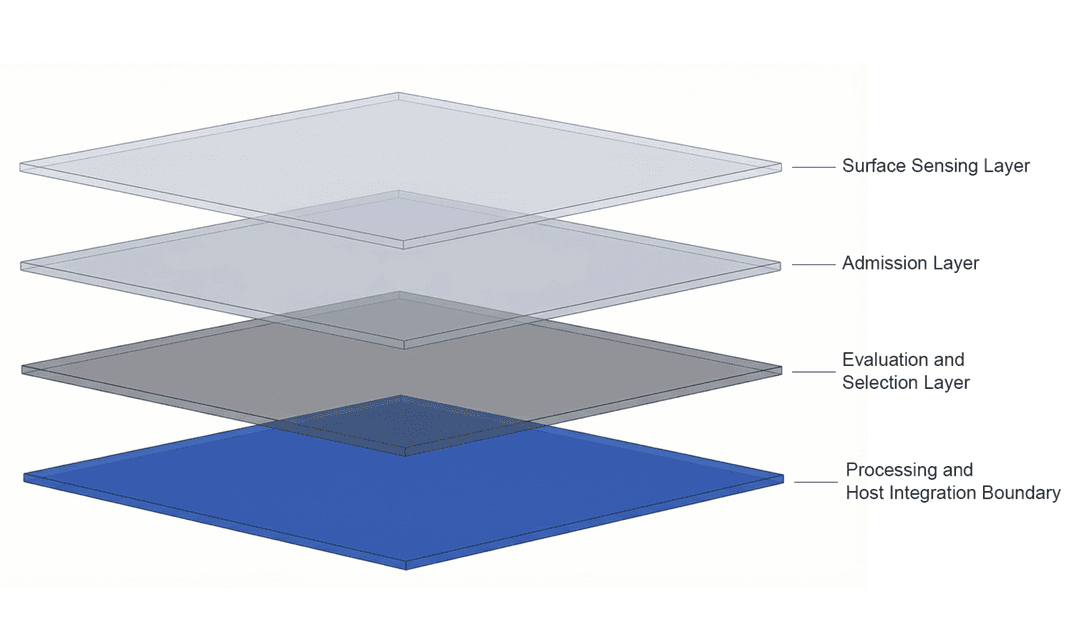
By contrast, TCS can be described as a surface-level physiological sensing architecture organized around interaction at the surface. Rather than beginning with a scene or capture volume, it begins with a distributed sensing field at the interface, admits a localized region associated with interaction, evaluates candidate signals from that region for suitability, and produces a disciplined output aligned to host integration. The architecture therefore treats sensing as a governed surface behavior rather than as unconstrained scene capture.
3. Key concepts
3.1 Coupling and boundary conditions
Camera systems typically depend on line-of-sight conditions and scene illumination. They observe the world at a distance, and their performance can be sensitive to placement, occlusion, and environmental lighting.
TCS is designed around contact coupling. When contact is present, the architecture may admit a localized region and obtain signals from a subset of sensing locations associated with that region. This contact boundary is central to how the system allocates power, manages acquisition, and disciplines export.
3.2 Data structure: frames versus time-domain physiological signals
Camera outputs are generally frame-based. Even when downstream software extracts time-series features, the upstream data remains a spatial reconstruction.
TCS output is typically a compact physiological time-domain signal derived from a bounded region of interest. The host may receive one or more structured signals that are suitable for downstream interpretation, rather than receiving scene content.
3.3 Privacy posture: scene content versus bounded physiological signals
Because cameras capture scenes, they can inherently include contextual visual information. Even when the target feature is not identity, the modality may still contain background context and bystander exposure, depending on deployment.
TCS is not intended to reconstruct scenes. A disciplined export model can support physiological sensing during contact without creating a general-purpose visual channel. Privacy and security posture remain integration choices, but the architectural intent is to bound acquisition and export around contact-admitted sensing.
3.4 System control: spatial admission and suitability gating
A key difference is how the system decides what to process.
Camera pipelines generally process whatever the sensor captures within the configured field of view, then rely on downstream software to select regions of interest.
TCS may use contact context to admit a region of interest first, then evaluate one or more candidate signals for suitability before exporting a structured output. This may reduce unnecessary acquisition, support stable signal formation, and help preserve normal surface behavior.
4. Implications for systems and OEM integration

4.1 Placement and industrial design constraints
Cameras typically impose placement and field-of-view considerations. This can affect industrial design, enclosure geometry, and operational constraints in real-world environments.
TCS integration is surface-native. It can be integrated at a point of interaction, where contact already occurs, while maintaining the familiar behavior of the host surface. This supports integration into interfaces where line-of-sight sensing is not desired or not practical.
4.2 Data pathways and system boundaries
Camera systems can introduce high-bandwidth data streams and more complex privacy governance because visual frames may be sensitive even when used for benign features.
TCS systems can provide more compact and bounded data pathways because the architecture is designed to export disciplined physiological signals rather than a general-purpose scene stream. The exact interface, bandwidth, and computation split are integration choices.
4.3 Operating environments
Cameras can be affected by lighting, occlusion, and background variability. Some deployments manage these constraints successfully, but the constraints are structural.
TCS deployments depend on contact patterns and the quality of coupling at the surface. The architecture is designed to evaluate suitability and adapt selection when conditions change, rather than assuming a fixed sensing position.
5. Category and platform posture
TCS is a surface-level physiological sensing architecture. This paper compares TCS with camera imaging to clarify architectural boundaries, data structure, and privacy posture, rather than to position TCS as an imaging modality.
This category distinction has practical consequences beyond terminology. It influences how OEM teams reason about privacy, risk, and governance, how system architects allocate bandwidth, compute, and power, and how integration work is framed inside a product organization.
A clean way to position TCS relative to cameras is:
- Cameras: scene acquisition and interpretation from spatial intensity fields
- TCS: contact-admitted physiological sensing with disciplined export aligned to host integration
Conclusion
Cameras and TCS can both involve optical components, but they serve different system roles. Cameras are typically designed to reconstruct scenes from a distance. TCS is designed as a surface-integrated physiological interface that can admit sensing based on contact context, evaluate suitability, and export disciplined physiological signals appropriate for host integration.
For OEMs, the practical takeaway is architectural: TCS enables physiological sensing where interaction already occurs, without introducing a general-purpose scene capture channel and without forcing product behavior to revolve around a dedicated sensor ritual.