System Composition of
Touchable® Cardiovascular Surfaces
How layered sensing, control, and host integration work together
Document ID:BSTH-WP-002|Version:1.0|Revision date:|Status:Public|Issued by:BioStealthAI|Draft start:2025-08Prepared by:BioStealthAI Systems Architecture Team|Lead author:Israel Ninsaw Gbati|Technical review:Mohamed Alezzabi, Olivier Tsiakaka, PhDIntended audience:Systems Engineers; Platform Architects; Physiological Sensing R&D Leaders|Contact:partnerships@biostealth.ai

Scope and disclosure note
This paper describes architecture-level concepts for surface-level physiological sensing. It is intended to clarify system topology, integration posture, and platform implications. Implementation specifics such as sampling rates, wavelengths, thresholds, physical dimensions, manufacturing recipes or material stack-ups vary by embodiment and are outside the scope of this paper. Examples are illustrative and non-exhaustive. System behavior and performance depend on embodiment, integration choices, and operating context. This paper is not a medical or diagnostic document.
Nothing in this document is intended to define, limit, or characterize the scope of any patent claims, or to constitute an admission about the state of the art.
Abstract
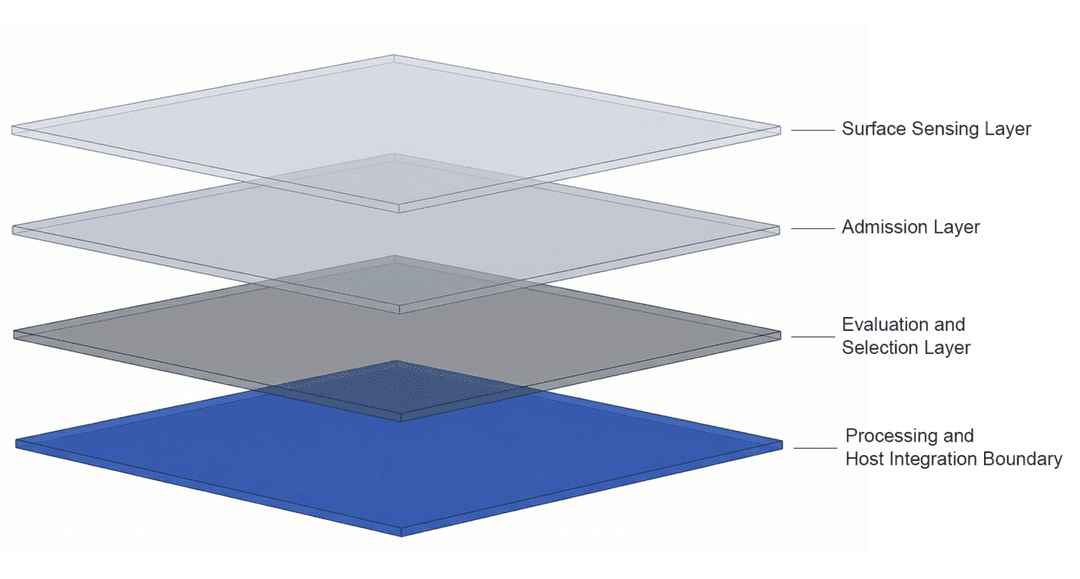
Touchable Cardiovascular Surfaces (TCS) can be described as a surface-level physiological sensing architecture with an explicit system composition: a surface of distributed sensing locations, an interaction-conditioned admission layer, a suitability gating and selection layer, and a disciplined interface to the host.
This document presents a structured description of that composition and its operational layering. The discussion is organized by hardware stack, activation and control behavior, signal conditioning and processing posture, power behavior, adaptive surface behavior, embodiment considerations, and integration interfaces. The purpose is to explain how distributed sensing locations, contact admission, suitability evaluation, and output discipline relate to each other across embodiments, without prescribing a particular implementation.
1. System overview.
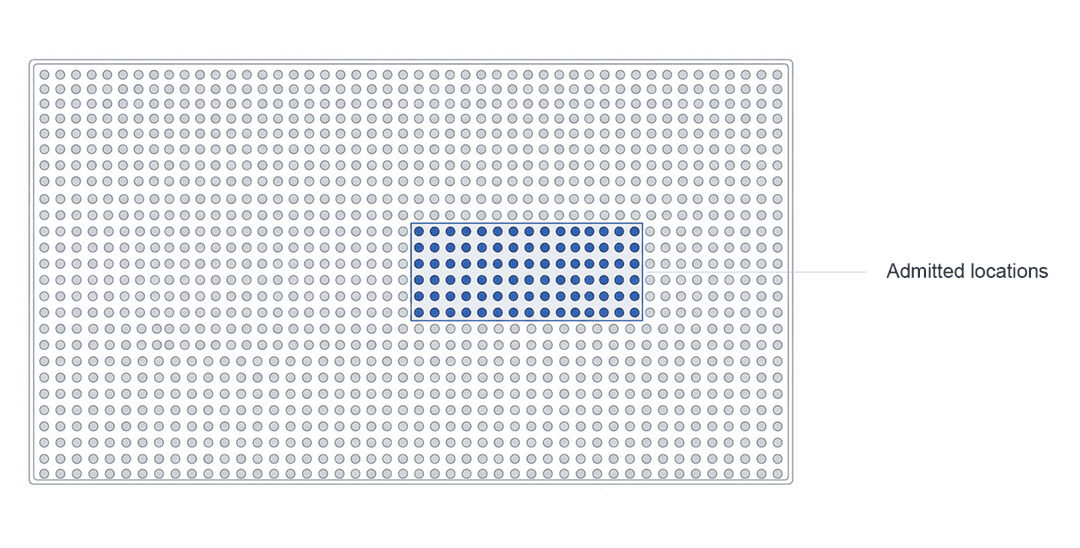
TCS surfaces consist of spatially distributed sensing locations embedded into a substrate or member that forms part of a host surface. At a high level, a sensing location can include:
- an illumination element suitable for physiological sensing in the intended embodiment
- a sensing element positioned to capture reflected or back-scattered light influenced by tissue and blood volume dynamics during contact
- an electrical interface that supports selective activation and signal acquisition
A common operational posture is the contact-conditioned posture: the surface can remain electrically quiescent until contact context is detected. When contact is present, a localized portion of the sensing field may be admitted and activated according to system policy. Signals acquired from admitted sensing locations may then be evaluated for suitability and routed into a disciplined output appropriate for host integration.
2. Hardware stack
This section describes the system in layers, from the user-facing surface down to the control and interface layer.
2.1 Surface layer
The surface layer is the contact surface of the host object, for example an input surface, a workstation contact area, or a tool grip zone. Depending on the product, the surface may be rigid, flexible, or curved. Optical properties of the surface can vary by embodiment. Some designs may use transmissive or translucent paths where light passes through a layer, while other designs may use routed optical paths within the structure. The architectural point is that the sensing topology can be integrated into a surface while preserving the familiar behavior of that surface.
2.2 Sensing layer
The sensing layer can be organized as a grid, a clustered layout, or a geometry-aware distribution that matches how users contact the surface. It can include:
- illumination elements selected for the intended sensing depth and surface constraints
- photodetectors selected for the optical geometry and field-of-view requirements
- isolation and shielding features that reduce cross-coupling between neighboring sensing locations, where needed
This layer supports the key architectural behavior: multiple candidate sensing locations may exist under a contact region, and a subset may be engaged and evaluated.
2.3 Signal conditioning layer
Signal conditioning can be distributed, centralized, or hybrid depending on embodiment. It can include analog and digital functions that support:
- baseline management
- filtering and noise suppression appropriate to physiological waveforms
- conversion into a representation suitable for digital processing and disciplined export
The composition of conditioning resources can be shaped by surface density, routing constraints, and integration policies, without changing the architectural principle of local admission and suitability gating.
2.4 Control and interface layer
The control and interface layer coordinates the architecture as a governed system rather than as a loose collection of sensing elements. Its responsibilities can include orchestrating admission and discipline across the surface, managing localized illumination and acquisition within admitted regions, receiving candidate signals, applying suitability policies, and producing structured outputs aligned to host integration. In this role, the layer is not merely a transport path. It is the system-level coordinator that shapes how the surface behaves under real interaction conditions and how the host receives bounded, usable outputs.
3. Activation and control logic
In this paper, touch and contact refer to the common case of a proximate object at the surface interface.
Many embodiments are organized around a contact-conditioned activation posture, followed by evaluation and disciplined routing.
3.1 Contact-conditioned wake and admission
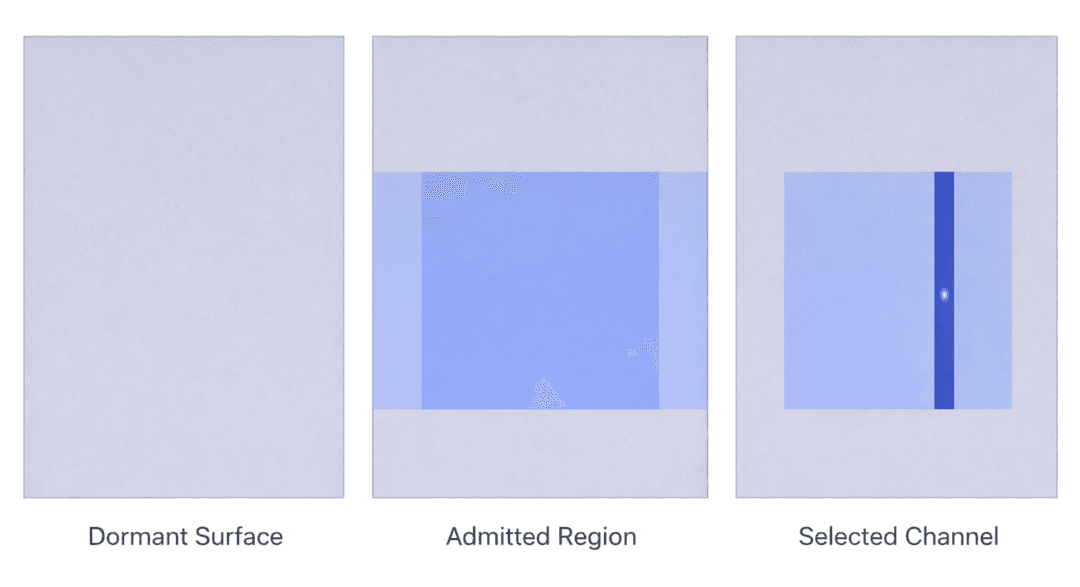
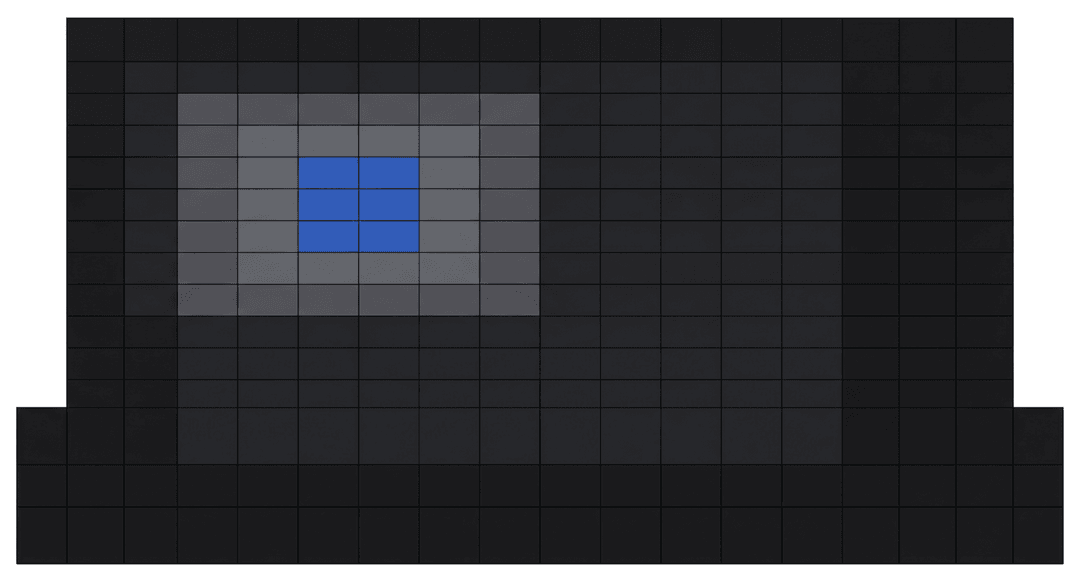
The system may operate in a low-activity state until contact context is detected through one or more surface-appropriate mechanisms. When contact is detected, the system may admit and activate a regional cluster of sensing locations associated with the contact point or contact area. This local admission supports power discipline and avoids treating the entire surface as continuously active.
3.2 Parallel candidate evaluation
Within an admitted region, multiple sensing locations may acquire signals for evaluation. Suitability criteria can be implementation-dependent and may include characteristics such as:
- coherence and stability of the physiological waveform structure
- sensitivity to ambient influence under the current optical conditions
- motion-related disturbance under the current contact dynamics
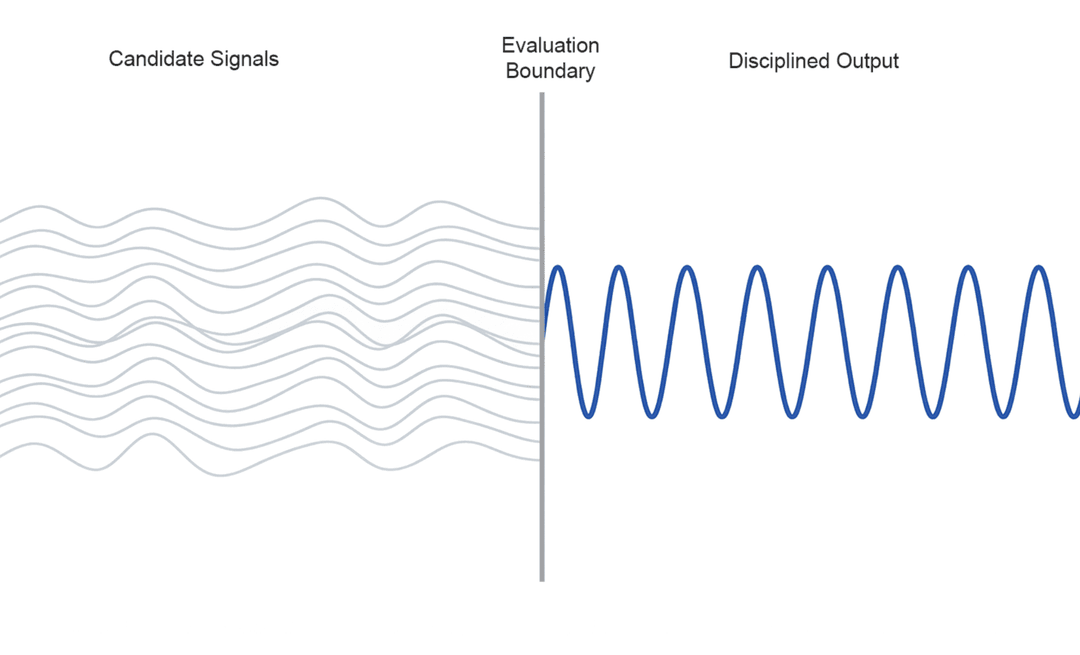
The objective is to qualify candidate signals before deeper processing and before export to the host.
3.3 Suitability gating, selection, and routing
When multiple candidate signals are available, one or more suitable signals may be selected for downstream processing. Selection policies may be static for a contact session or may be updated as conditions evolve. In some embodiments, a system may forward a primary channel at a time for a simplified host integration path, while other embodiments may support more than one concurrent channel depending on use case and policy.
Routing is governed by the same architectural intent throughout: keep the output disciplined, bounded, and aligned to the host’s needs, rather than exporting uncontrolled surface-wide raw data.
4. Signal processing architecture
Signals acquired during contact can include physiological waveforms consistent with photoplethysmography, representing volumetric changes in blood flow that modulate reflected or transmitted light.
4.1 Pre-processing posture
Pre-processing can include a combination of analog and digital steps designed to stabilize the signal for downstream use, for example:
- band-limiting and noise suppression appropriate to physiological waveforms
- management of ambient influence through coordinated illumination and sensing policies
- optional smoothing and artifact suppression consistent with real-time operation
This is presented as an architectural posture rather than an implementation prescription.
4.2 Feature and output formation
Depending on integration choices, and in embodiments specifically configured and validated for such indicators, the system may compute or package indicators such as heart rate, variability-related measures, pulse waveform characteristics, blood pressure trend surrogates, vascular tone related indicators, blood oxygen saturation and waveform morphology characteristics such as rise and decay behavior.
These outputs may be produced at the surface boundary, on a nearby controller, or on the host system. The architectural point is that the surface can deliver disciplined outputs suitable for integration, with the division of labor dependent on the system design.
5. Power behavior
TCS is designed to support low-activity states when no contact is present and localized activation when contact occurs.
Typical operational postures can include:
- dormant posture: illumination disabled and acquisition minimized or conditioned by policy
- contact posture: local illumination and sensing engaged in the admitted region, potentially duty-cycled and scheduled
- streaming posture: sustained acquisition from one or more selected sensing locations, with illumination and acquisition coordinated to maintain signal integrity and system efficiency
With appropriate policy and embodiment choices, a large surface may be operated in a way that remains comparable to point-based sensing in practical power envelopes, while retaining the benefits of spatial admission and adaptive selection.
6. Surface intelligence and adaptive behavior
TCS surfaces behave as spatially intelligent fields because admission, evaluation, and routing occur in response to real-world interaction patterns.
Several system properties follow from this architecture. First, it is selective: sensing activity can be localized to admitted regions rather than spread uniformly across the full surface. Second, it is local: acquisition and evaluation can occur at the point of interaction rather than requiring global participation. Third, it is responsive: the active sensing region and selected channel can adapt as interaction geometry changes. Finally, it is redundant in a constructive sense, since multiple candidate locations can be available within an admitted region, allowing the system to preserve continuity by selecting among them under changing conditions.
This allows the surface to act as a context-sensitive interface rather than a uniform always-active sensor matrix.
7. Embodiment considerations
TCS can be integrated into a range of surface geometries and product constraints.
Embodiments may include:
- curved or irregular surfaces
- flexible or semi-rigid substrates
- objects with limited surface area but high interaction frequency
Routing, encapsulation, and control allocation can be adapted per embodiment. The core architectural principles can remain consistent: contact-conditioned admission, local suitability evaluation, and disciplined output aligned to the host.
8. Integration interfaces
TCS surfaces are designed to integrate as subsystems in larger platforms through standard host interfaces appropriate to the product class.
Integration may include:
- wired interfaces suitable for low-latency streaming in consumer and industrial systems
- embedded interfaces suitable for microcontroller-based host architectures
- wireless telemetry interfaces suitable for constrained bandwidth reporting, where appropriate
Outputs may be packaged in structured formats that support integration, for example with timing context, waveform segments, and associated feature tags or metadata, depending on policy. The emphasis remains on disciplined export rather than raw surface-wide data exposure.
Conclusion
Touchable Cardiovascular Surfaces can be understood as a composed system: a surface of distributed sensing locations, contact-conditioned admission, local suitability gating and selection, and disciplined physiological output suitable for host integration.
The architecture is modular and geometry-aware. Surface behavior is shaped by the interplay between contact geometry, signal suitability, and surface topology. This system composition enables a surface to behave as a physiological interface during interaction while preserving familiar surface behavior.